The Tracker Project
The Tracker project started off as the Backup Tracker. The goal was to provide a backup system to track a high altitude balloon to assist in the recovery of the payload.
For a little background, HAB4 was the fourth iteration of SFUSAT's introductory high altitude balloon project. The goal of HAB4 was to provide students with hands-on experience in building, launching, and recovering a high altitude balloon payload while also conducting scientific experiments. The payload included various sensors to collect data on temperature, pressure, humidity, and radiation levels at different altitudes.
On the radio communication side, HAB4 has a primary LoRa radio system to transmit telemetry data back to the ground station. The radio system operated on the 915 MHz frequency band, which is commonly used for amateur radio and IoT applications. The LoRa radio provided long-range communication capabilities, allowing the payload to transmit data over several kilometers.
When the payload was on its way back to Earth, at some point we'd lose line of sight and radio contact. The Backup Tracker was designed to assist at this stage, using the GPS of a phone and a script to send the location using a cellular connection.
To achieve this, I built a proof of concept with Cloudflare Workers, an old Android phone, Automate, and Grafana. The telemetry data from the phone would be sent to a Cloudflare Worker endpoint using HTTP POST requests. The Worker would then save the telemetry to PostgreSQL which Grafana would use to visualize the data on a dashboard.
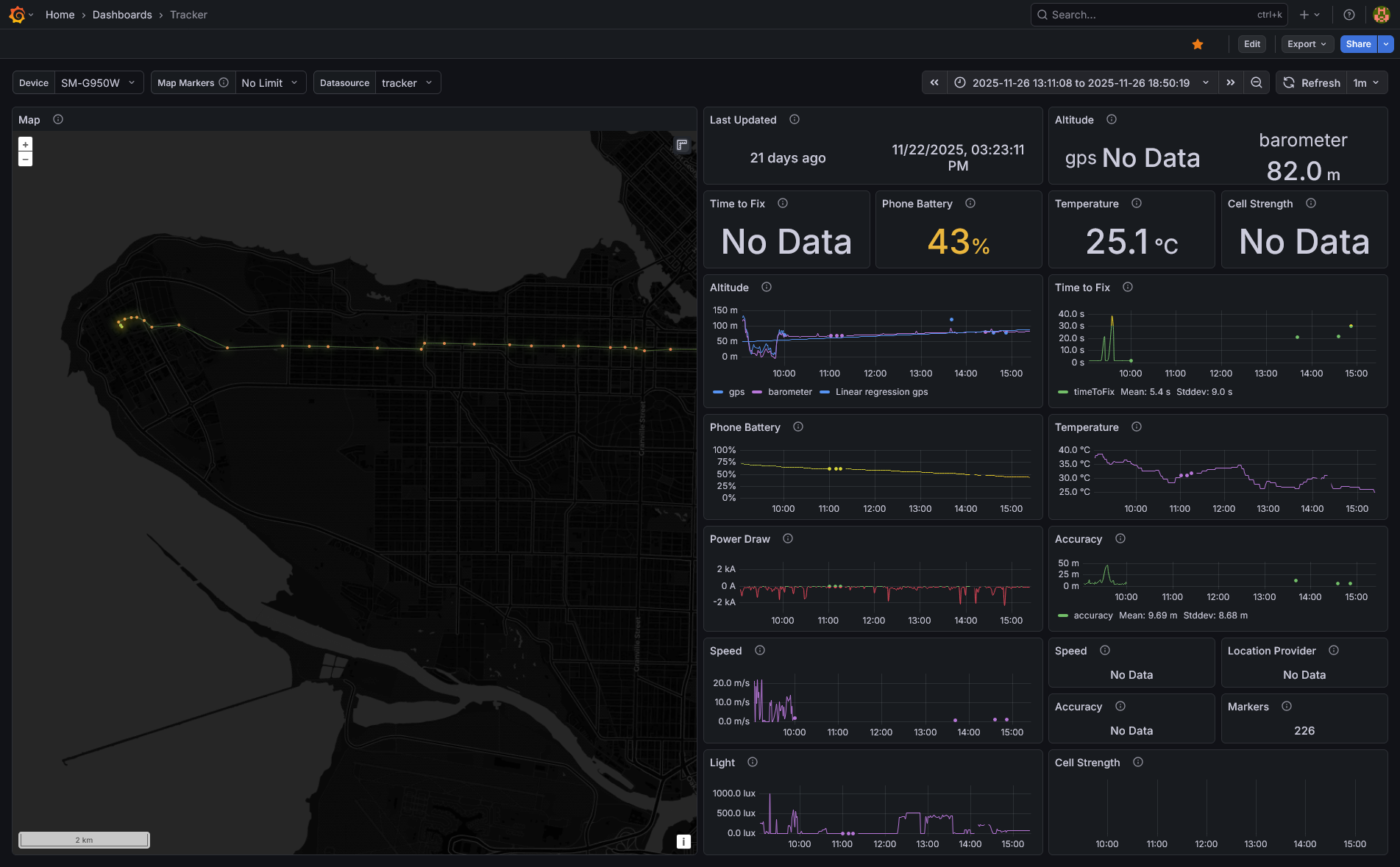
This Grafana dashboard concept was also ported to the primary tracking system too, letting us have good data visualization. Due to "insurance" reasons, HAB4 never got to fly. However, the Backup Tracker concept was solidified. After HAB4, I decided to expand the Backup Tracker into a more general-purpose Tracker project. With a backend rebuild and a new Android app to send telemetry, v2 of the Tracker project came into being.
Nowadays, it's much closer to a Google Maps Timeline alternative. While it is in no way easy to set up, it does provide a privacy-focused way to track and log your location over time, which is my current use case. It also provides a platform to mess around with other technologies, like gRPC and Protobufs.
Since its inception, it's collected nearly 2 million location point, tracking me everywhere I go.